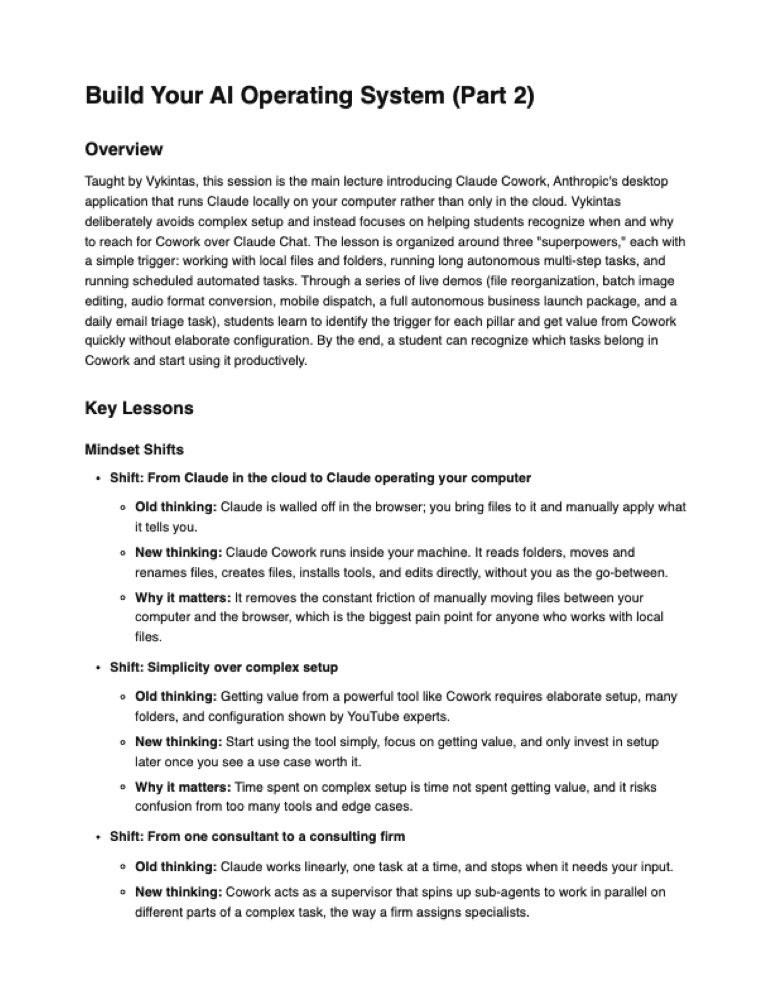
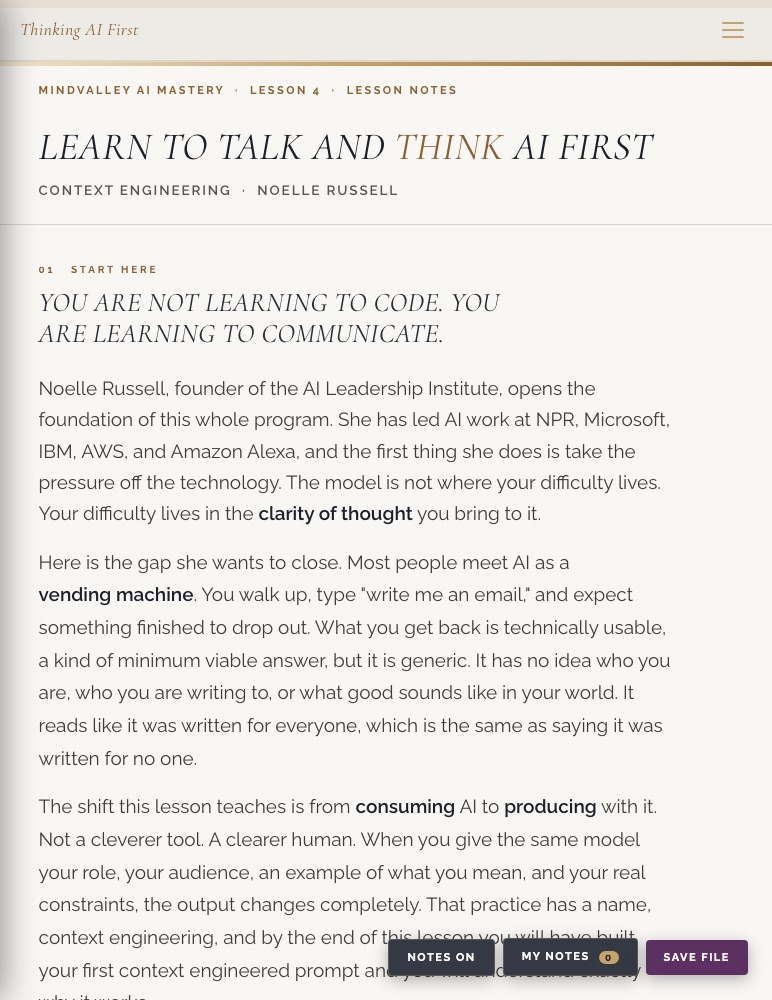
The lesson in the program's own summary structure, and in the program's own look rather than mine: mindset shifts, frameworks, tools, demo walkthroughs with reproducible steps, and takeaways. Carrying my branding here would have contradicted the thing it is claiming to be.
Mindvalley AI Mastery 2026
Notes you can work inside, not a folder of summaries.
Every session in this program gives you more than you can hold in your head at the time. These pages are where that material settles. Each one documents what a lesson taught, in enough depth that you can come back six months later and still be able to build from it.
What follows is four lessons from a longer series that runs across the whole program. They are consecutive on purpose. Lesson four teaches the thinking, five puts it to work, six shows you a working AI team, and seven has you build your own. Each one leans on the one before it.
Picking four consecutive lessons rather than four scattered highlights was deliberate. It is how I could show that the pages carry a through-line and speak to each other rather than sitting in a pile.
Four consecutive sessions, in the order they were taught.
The series alternates. A teaching session introduces the idea, then an implementation lab puts it to work the same week, so each pair moves from understanding a thing to having built one. Read them in order the first time.
The program stopped writing summaries, so I built the replacement.
Partway through AI Mastery, Mindvalley announced it would stop producing the written lesson summaries. That mattered more than it might sound, because video on its own is not something I can search, annotate, or come back to six months later and still get anything from.
Rather than wait to find out whether it would hold, I built what I needed. The decision was reversed later, after the community pushed back, which told me the need was real and not only mine. By then these pages already existed.
I have never written a line of code, so I relied on Claude to build this. The part I played was deciding what it needed to be, writing down the rules it had to hold to, and then reviewing what came back hard enough to find what was still wrong with it. Every standard I care about now lives in a check that fails the build rather than in something I have to remember. The pages being good matters less than the standard holding without me.
The library is a sample, not a product. Four lessons built to the standard a full library would be held to, from a system that has since rebuilt a second, unrelated program from scratch without modification.
One transcript, three different artifacts.
Three skills read the same lesson transcript and produce three different things, because reading to revise, reading to think, and reading to reference are not the same task. The interactive pages below are only one of the three. Each one opens as a page in this portfolio showing the exported document itself, not a copy of it.
All four are the same lesson, Build Your AI Operating System (Part 2), so they can be read against each other.
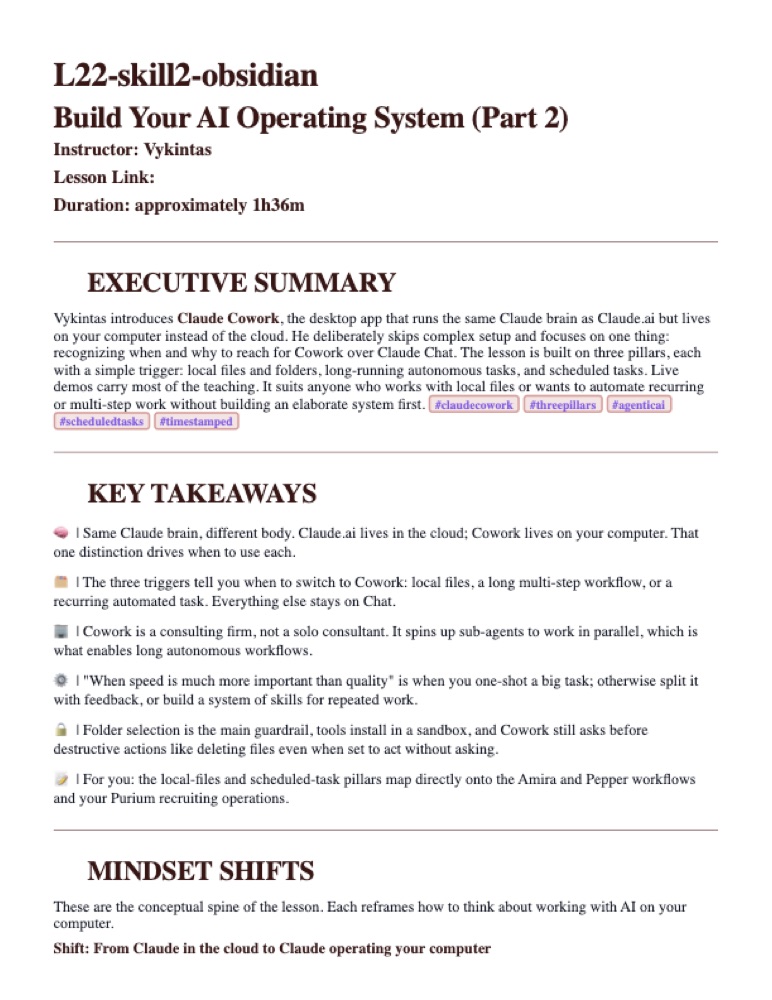
The same lesson reorganized for a knowledge base, with inline timestamps back to the recording and a personalization layer that reads a written Personal DNA profile. It carries "For you" passages that map the material onto the reader's own work.
The identical skill run with the personalization removed. Read beside the one before it, this is the argument: same engine, same depth, the personal layer swapping cleanly out rather than being welded in. It degrades to clearly marked general examples instead of breaking.
The format this library is built in. Full text search across every lesson, narrated audio, highlighting and notes that persist, reading progress, and retrieval practice cards. Four are built and live, and they are listed in the next section.
A separate run reproduces the program's official summary template as closely as the rules allow, so the replacement could be measured against the thing it replaced rather than just asserted to be as good. Seventeen differences were found and written up; the ones worth fixing became rules in the skill. Read the replica →
The rest of the series.
Listed so the shape of the whole thing is visible. These sessions build directly on the four above, and their notes are not written yet.
Read them in order, once. After that, use them out of order.
Four, five, six, seven. Each page opens by picking up where the last one ended, and the intermediate pair will feel abstract if the beginner pair has not landed yet.
Come back for the piece you are missing. The copy blocks and the quick reference at the foot of each lesson are built for exactly that, so you can take the one thing and go.
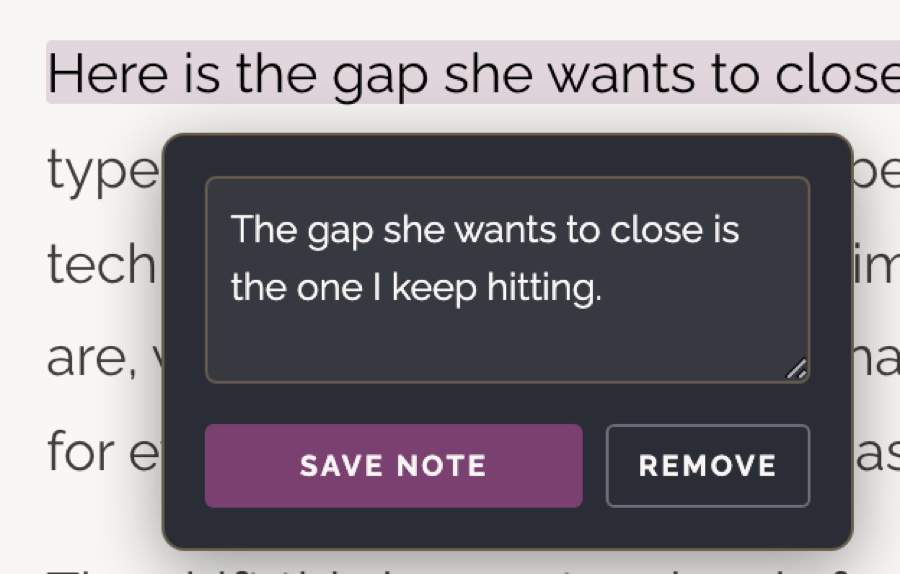
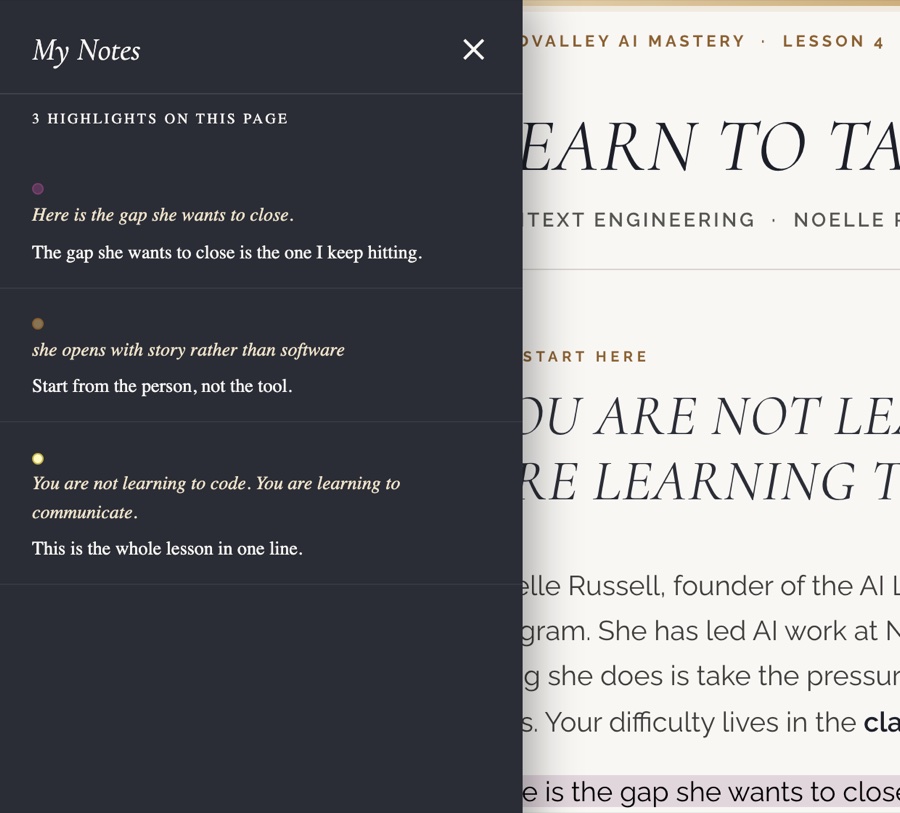
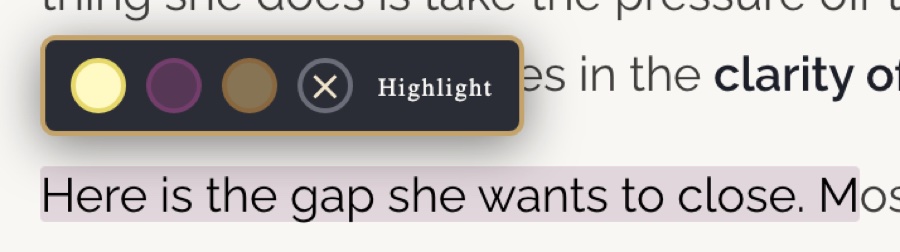
Select any passage to highlight it, tap the dot it leaves behind to attach a note, and gather everything you marked from the notes button. Save the file and your marks travel with it.
Each lesson carries a spoken version of about ten minutes that teaches the real substance rather than trailing it. Useful before a session, and useful again a week later.
A system, not a set of one-off pages.
Every page here is produced by the same authoring system: one stylesheet written once rather than patched, a validator that fails the build on contrast, centring, spacing and orphan errors before a page ships, and a search index compiled into this opening page so the whole library is searchable with no server behind it.
Each page is a single self-contained HTML file. Highlights, notes and reading progress are saved in the browser. The narration is generated from the lesson script and streamed from object storage.
Thank you for spending time with this.