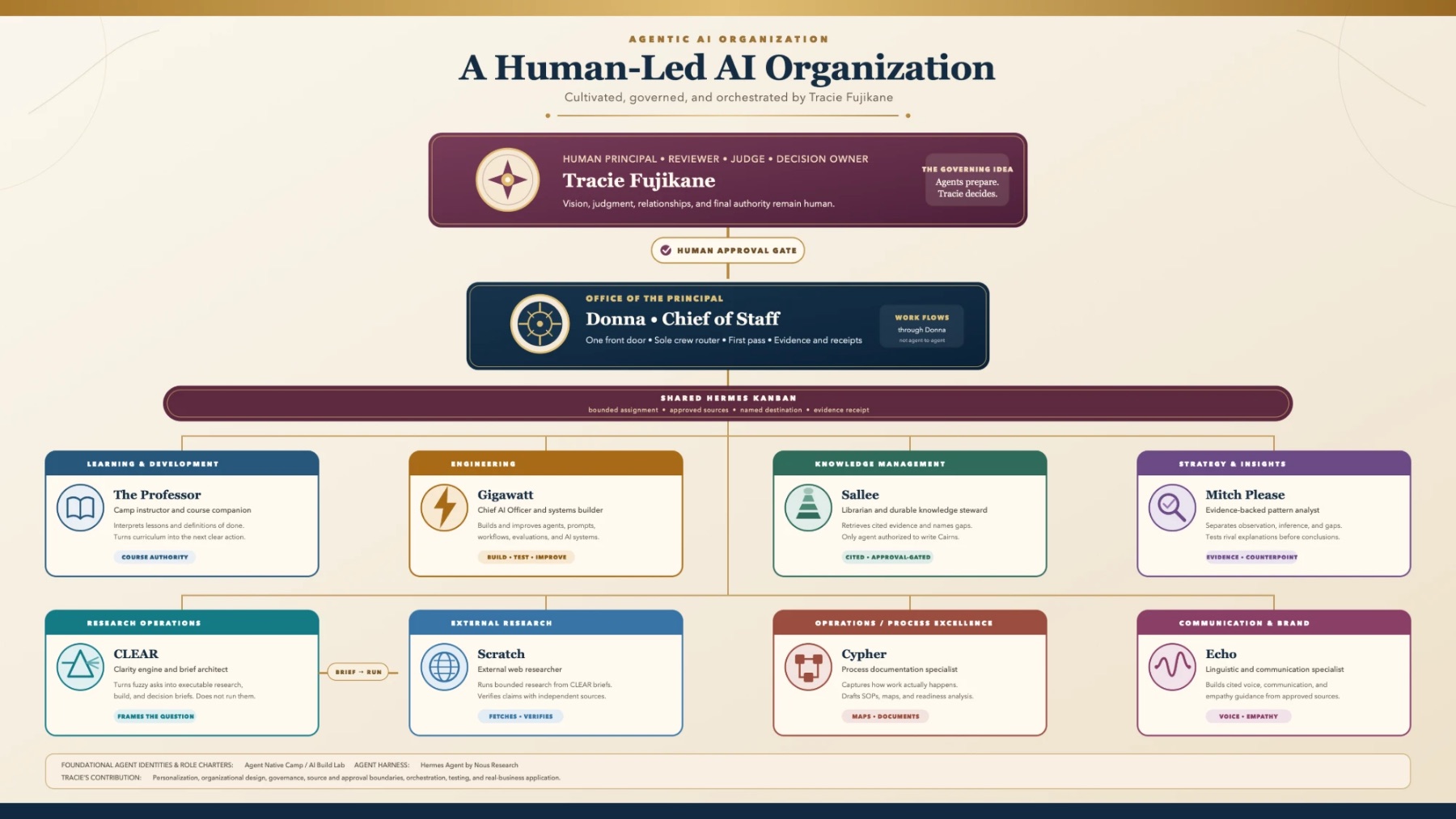
Every request passes a human approval gate and routes through one chief of staff rather than agent to agent. Each assignment carries a bounded task, the sources it is allowed to draw on, a named destination, and a receipt when it is done. Eight specialists sit beneath that with written charters.
A message bus between eight autonomous agents is a system nobody can audit. One front door is slower and it is reviewable, and reviewable is the only version I would put near a real business with real customers and a real team.
One assignment, traced end to end.
Every one by the router
Checkable, not claimed
In one audit
All of them held
A nightly ingestion window failed and left gaps in my private knowledge system. What my chief of staff did next is the whole argument for building it this way.
Donna did not search broadly and did not write around established authority. She created a bounded task for Sallee, the organization's sole knowledge-maintenance specialist, and let the specialist do the specialist's work. That sounds like a small distinction. It is the difference between a system that repairs itself inside its boundaries and one that quietly widens them whenever something goes wrong.
What the specialist came back with:
- 672 local session records audited. The full corpus, not a sample.
- 28 missing conversations preserved as paired source evidence and distilled cards.
- 86 machine-only sessions excluded as ineligible rather than swept in to pad the count.
- Four secret-bearing candidates quarantined without copying a single value in.
- A sanitized receipt returned showing zero unresolved eligible gaps.
The path that work took.
Every step above is recoverable after the fact. The authority is written down, the boundary is written down, and the proof comes back along the same route the assignment went out on. That is the difference between an agent I trust with my knowledge base and one I would not.
I approved a narrowly defined class of local knowledge writes. I explicitly withheld authority for changes to the top curated layer, for publication, for commits, for pushes, and for any external action.
The permission was not "fix the knowledge base." It was a shape with edges, and the edges were the point. An agent that can repair a gap is useful. An agent that can repair a gap and cannot publish, push, or reach outside the machine while doing it is something I can leave running.
AI Mastery is the ground all of this stands on.
When I came to Mindvalley, AI was a new concept for me. By attending the lessons and applying what was being taught, I gained understanding and a level of confidence I have been able to carry forward.
Watching my first AI Summit in 2024 changed the way I think and move through the world. How I approach communication and processes affects every aspect of my life now, not only the technical parts of it.
As someone who has never touched code, this opened up opportunities to be creative and bring ideas to life that I would never have dreamed of. I know I have a great deal more to learn. What I have done is make a real effort to implement the things I could see a practical use for. That implementation became a foundation, and it points two ways: deeper into agentic systems on one hand, and on the other, helping other people find ways to leverage AI, if not learn it themselves.
When I say I learned skills here, I mean it in both senses. There are Skills in the technical sense, the packaged instructions these agents are built from, and I did learn to write those. The larger thing was a way of working. Being precise enough that a system can act without me in the room, and putting a rule somewhere it will hold rather than trying to remember it.
This agent organization is a nod to how far I have been able to come, from not knowing anything about AI at all to being closer to the forefront of it. My intention is to show the arc of the story and where it started. The best is yet to come.
Pepper worked. That is what created the next problem.
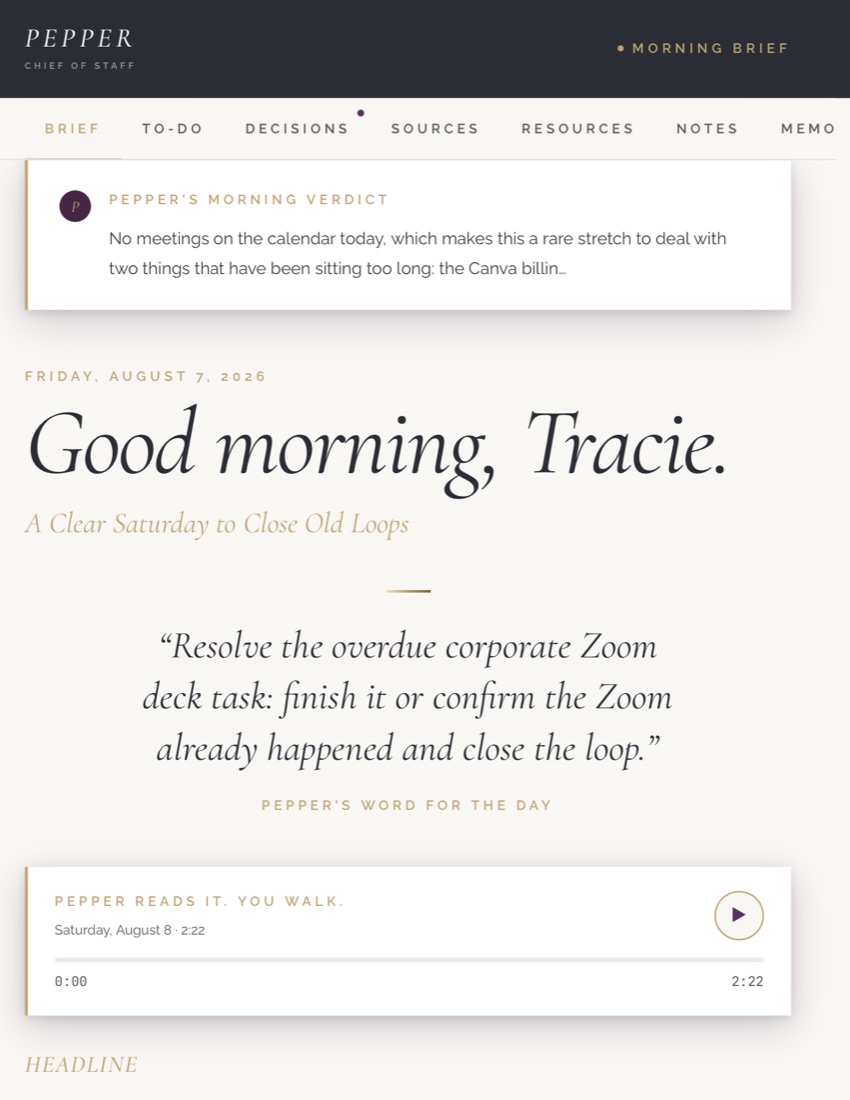
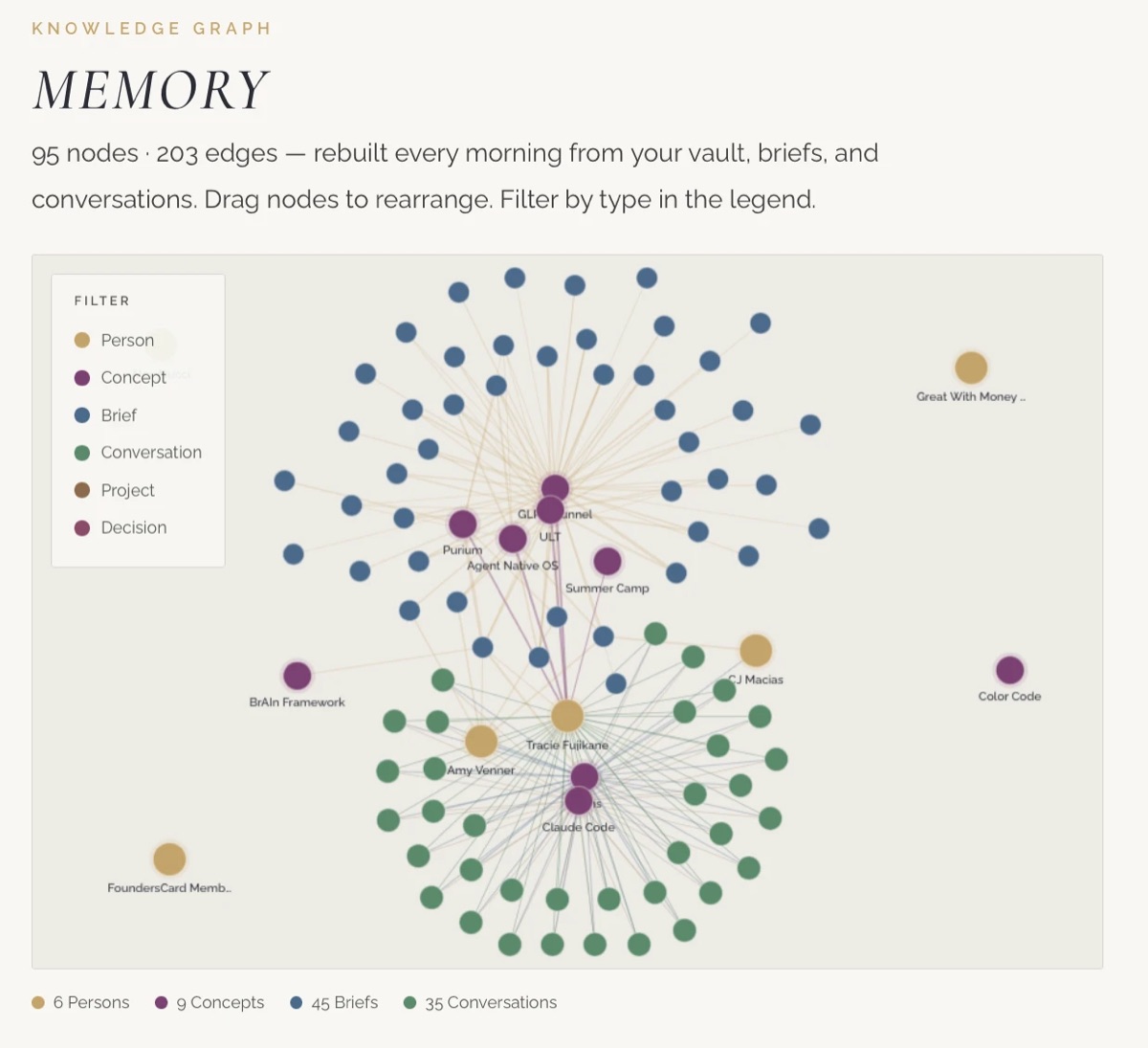
Pepper is a chief of staff: it assembles a brief before the day begins, reads it aloud if I would rather walk than sit, and keeps its own memory of what it has learned about how I work.
Once one agent is useful, the temptation is to give it everything, and an agent given everything becomes an unreviewable single point of failure. The question changed from what one agent could do for me to how several of them should work together, which turned out to be a question about organizational design rather than about models.
The proof is not what the agents did. It is what they refused to write.
Autonomy is easy to demonstrate and easy to fake. What I look for is an agent that completes substantial work and then writes nothing, because approval has not come.
There are eleven receipts on file. They record what was asked, which sources were approved, where the output was allowed to go, and what state the work is in. Work sits at proposed, review required until I move it, and one receipt records a payload written under approval that still needed review before it could be committed. A write ledger records what has landed, so the question of what an agent changed has an answer I can read rather than one I have to trust.
"No repository file, Cairns file, Obsidian file, canonical reference, or raw corpus file was written or modified."
The agent had finished the work. It proposed exactly where the result should be routed, listed the route it had not applied, and stopped.
The knowledge audit below produced the same behavior under more pressure. Sweeping 672 sources, it found four candidates carrying secrets and quarantined them rather than filing them. Nothing about the assignment required that; the boundary did.
One agent's output is another agent's instructions.
Two runs, by two specialists, on real material rather than demonstrations.
Echo, communication and brand: the voice analysis
A voice-emulation profile built from my own recorded speech, now read by every other agent that writes anything in my voice. It measures sentence length, reading grade, type-token ratio, comma density and sentiment, and separates two registers I did not know I had: a short polished one for lines I have taught many times, and a longer spiralling one in live conversation that resolves on a blunt landing. Its conclusion about my small working vocabulary is that the repetition is pedagogy rather than a limitation, which is right, and which nobody had said to me before.
Four attributed samples
Sourced, not paraphrased
Run on my turns only
One canonical copy
It is careful in the way I would want a person to be careful. The other trainer's segments and my teammates' words were excluded from the counts, and the source of every sample is named.
Sallee, knowledge management: the coverage audit
The only agent permitted to write to my knowledge base, auditing what was already in it. It classified human conversations separately from canaries, machine workers, empty runs and background jobs, compared source hashes against existing coverage, staged only the missing eligible pairs, scanned every candidate for secrets before writing, wrote create-only with no overwrite, validated filenames, frontmatter, hashes, backlinks, duplicates and approved paths, rechecked for remaining gaps, and filed a sanitized receipt.
| Measure | Verified receipt result |
|---|---|
| Source conversations or snapshots discovered | 672 |
| Already covered by exact source hash | 554 |
| Newly backfilled conversations | 28 |
| Machine-noise sessions excluded | 86 |
| Secret-bearing candidates quarantined | 4 |
| New source artifacts | 28 |
| New distilled cards | 28 |
| Unresolved eligible gaps | 0 |
| Changes to the top layer | 0 |
Two numbers carry the entry, and the first is that the four secret-bearing candidates were not copied in. And the top layer of my knowledge base, the part I curate myself, was left untouched: zero changes, by an agent that had permission to write and a reason to.
Where each piece of this came from.
| Element | Origin |
|---|---|
| Foundational agent identities and role charters | Agent Native Camp and AI Build Lab |
| Agent harness | Hermes Agent by Nous Research |
| Memory architecture, worked on, vetted and built upon | Existing structure, extended by me |
| Organizational design and reporting structure | Mine |
| Governance: the approval gate, routing through one chief of staff | Mine |
| Source custody and approval boundaries | Mine |
| Orchestration, testing, and real-business application | Mine |
| Personalization from my own corpus | Mine |
I did not invent the agents and I am not going to imply that I did. What nobody handed me was the gate, the custody model, or the receipt discipline. Those exist because I decided that a system operating inside a real business does not get to write anything it likes wherever it likes. That decision is the work.
The organization is early. Eight charters, eleven receipts, one specialist output the other agents already depend on, and one audit across 672 sources is a beginning rather than a finished thing. It runs on real work rather than demonstrations, which is the only condition under which the governance gets tested at all.
Thank you for spending time with this.